Thursday, November 24, 2011

Three Part Series on Patent Valuation Covered by IP Osgoode and Jurisdynamics


IP Osgoode, Jurisdynamics and BioLaw are covering our group's recent work on patent valuation as it relates to the complex innovation ecology for pharmaceuticals we have termed the regulated Therapeutic Product Lifecycle (rTPL).

Parts 1, 2, and 3 of the series highlight our group's recent empirical work on new and follow-on drug approvals, products, patents, patents listed on the patent register, as well as our new innovation index for qualitative patent valuation.

The series comes out ahead of a forthcoming book summarizing our group's research over the last four years, entitled Patently Innovative. The book is due out in late 2011 or early 2012.

The first piece in the series introduces the issue of patent valuation in the context of the regulated Therapeutic Product Lifecycle (rTPL) innovation ecology discussed in our earlier work on complex legal systems. The second reviews two novel methods our group has just published in law reviews out of Boston and Santa Clara for a harmonized quantitative analysis of drug approvals, products, and patents and a novel qualitative innovation index for approval and patent valuation. In the third article of the series, the innovation index model is partnered with a cluster-based model of global drug development developed recently by our group that is strongly enabled by current and historical patent and innovation policy.

Innovation Incentives Part 1: Regulated Therapeutic Product Lifecycle

  • http://jurisdynamics.blogspot.com/2011/11/innovation-incentives-part-1-regulated.html
  • http://biolaw.blogspot.com/2011/12/innovation-incentives-part-1-regulated.html

Innovation Incentives Part 2: Patent Valuation

  • http://www.iposgoode.ca/2011/11/anovelinnovationindexforlifesciencesinventions/
  • http://jurisdynamics.blogspot.com/2011/12/innovation-incentives-part-2-patent.html
  • http://biolaw.blogspot.com/2011/12/innovation-incentives-part--part-2-patent-valuation

Innovation Incentives Part 3: Combining Patent Valuation with Product Cluster Models

  • http://www.iposgoode.ca/2011/12/patent-valuation-part-2-combining-the-innovation-index-and-product-patent-clusters/#more-14807
  • http://jurisdynamics.blogspot.com/2011/12/innovation-incentives-part-3-combining.html
  • http://biolaw.blogspot.com/2011/12/innovation-incentives-part-3-patent-valuation-and-clusters.html

I look forward to comments on the work. Cheers. R.


Saturday, August 6, 2011

Cover Art- New Book


The cover for the new book on pharmaceutical innovation is completed.

The book is entitled "Patently Innovative: How Pharmaceutical Firms Use Emerging Patent Law to Extend Monopolies on Blockbuster Drugs," and is set to come out towards the end of the year.

The publisher is: BioHealthcare Publishing Limited (Oxford UK).

A description of the contents can be found at: http://www.amazon.com/Patently-Innovative-Pharmaceutical-Monopolies-Blockbuster/dp/1907568123.

Tuesday, June 7, 2011

Kiva June 7 2011


Our beloved Golden Retriever Kiva passed away today of complications due to a tumor. He was 14 years old, and will be sorely missed by Ron, Pat, Rhael, Naomi and Zoe, as well as anyone else who was fortunate to come into contact with him.

Thank you to everyone who nurtured and cared for "The Beev."

Wednesday, June 1, 2011

Update on QIP-1 and QIP-2


I am pleased to announce that the two Qualifying Intellectual Property papers mentioned in an earlier post (QIP-1 and QIP-2) have been accepted for publication with excellent U.S. law reviews as of June 1st.

QIP-1 is in press with the Boston University Journal of Science and Technology Law.

QIP-2 is in press with the Santa Clara Computer and High Technology Law Journal.


Friday, April 29, 2011

New CMAJ Article


A policy paper on pharmaceutical innovation and its relation to intelelctual property law written with two health economist colleagues, Paul Grootendorst (Toronto) and Aidan Hollis (Calgary), will be published in November 2011 in the Canadian Medical Association Journal (CMAJ).

The article is entitled "Canada's Pharmaceutical Intellectual Property Laws: The Case For Fundamental Reform."

The Abstract is:

  1. The regulations governing intellectual property protections for brand (innovative) drugs in Canada have generated a very large amount of litigation between brand and generic drug companies, costing over $100 million annually; these costs inevitably are passed on to drug plans and consumers.
  2. One reason for this is the complexity and legal uncertainty created by three different, yet intertwined legal mechanisms (the Patent Act, the NOC Regulations and the data protection regulations); another reason is that regulations have given brand and generic drug companies the tools to contest the period of market exclusivity.
  3. Recent provincial drug plan decisions to reduce generic prices to as low as 25% of the brand price may reduce the incentive for generic firms to contest market exclusivity, possibly resulting in longer exclusivity periods and higher costs to payers.
  4. One solution to these problems is to offer fixed periods of market exclusivity to innovative drugs; this would at once enhance investment certainty to brand firms, and markedly reduce litigation, as brand and generic firms would be less able to contest market exclusivity
The article is available on the CMAJ website and from the authors.

Qualifying Intellectual Property (QIP) Papers

The author's research group has completed two substantial empirical studies on innovation in the pharmaceutical sector. The ensuing articles are entitled:

"Qualifying Intellectual Property I: Harmonized Measurement of Drug Approval, Drug Patenting and Chemical Components."

The purpose of this study was to develop a harmonized method to collect, compare and quantify regulatory approval data from multiple cohorts of new and follow-on drugs that encompassed all drug classes enumerated, described and prioritized by domestic drug regulators. A secondary purpose was to go beyond simplified descriptors of new and follow-on drugs in the literature, and to categorize classes of new, line extension and generic approvals according to the nomenclature used by regulators themselves.

"Qualifying Intellectual Property II: A New Innovation Index for Pharmaceutical Products."

To date innovation is measured using almost exclusively using quantitative methods, particularly with regard to patents. However, even though quantitative models are widely considered to be problematic, a model that assesses patent value using qualitative methods has not yet emerged. Here, a qualitative innovation index is reported that may fill some of the gaps in patent valuation. An innovation index for pharmaceuticals is described that provides a measure of patent quality that is specific to pharmaceutical products. The index is based on regulatory preferences and evidentiary requirements for various types of new and follow-on drugs and yields a method that is not only graded incrementally but which reflects the social value of the products being valued.

The Articles are available at:

BePress:
http://works.bepress.com/ron_bouchard/13/
http://works.bepress.com/ron_bouchard/15/

SSRN:
http://papers.ssrn.com/sol3/papers.cfm?abstract_id=1809826
http://papers.ssrn.com/sol3/papers.cfm?abstract_id=1809817

Friday, December 17, 2010

Talks at Canadian PTO and Industry Canada


I gave two talks on the group's work to the Government of Canada in Ottawa in late 2010 to Industry Canada and the Canadian Intellectual Property Office (CIPO).

Both of talks were well attended, and both audiences provided excellent comments.

I am grateful to leadership in the Government of Canada for facilitating the talks, particularly Mona Frendo at Industry Canada, Mary Carman and Konstantinos Georgaras at CIPO, and David Lee at Health Canada.

Friday, September 17, 2010

Structure-Function Study of Global Pharmaceutical Linkage


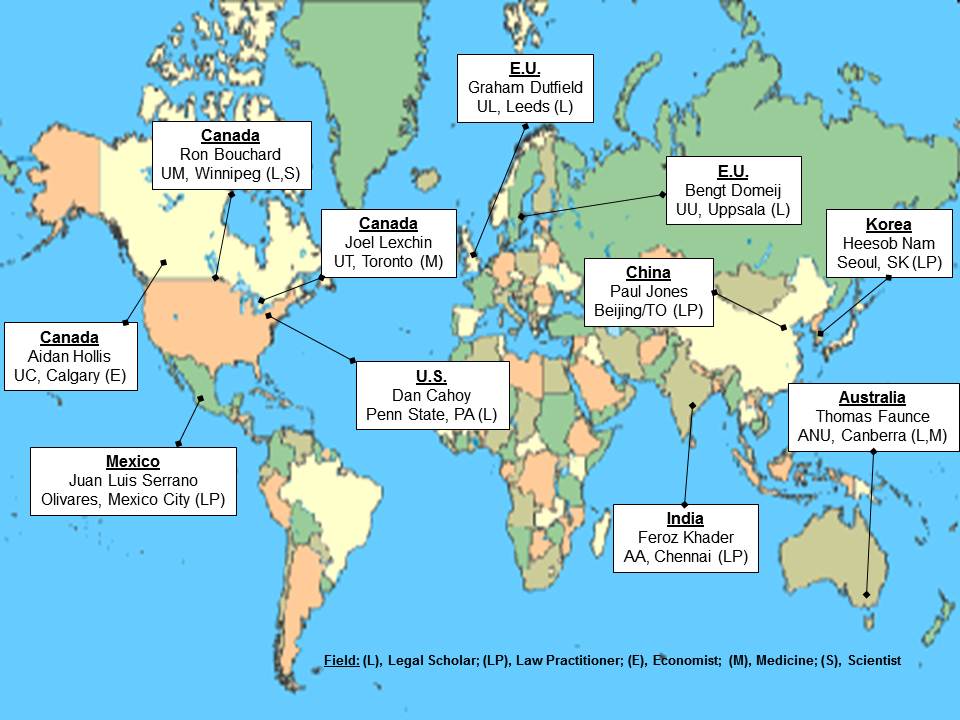
I am pleased to be part of a new global consortium of eleven intellectual property law and health policy scholars, economists, and practicing lawyers in nine counties. The group is called the Consortium Study of Global Pharmaceutical Linkage.

The Consortium is spread across nations with established, maturing, and nascent linkage regulations as follows:

  • Canada: Ron Bouchard
  • Canada: Aidan Hollis
  • Canada: Joel Lexchin
  • U.S.: Dan Cahoy
  • EU: Bengt Domeij (Sweden)
  • EU: Graham Dutfield (U.K.)
  • Mexico: Juan Louis Serrano
  • Australia: Tom Faunce
  • China: Paul Jones
  • South Korea: Heesob Nam
  • India: Feroz Ali Khader

The Consortium includes individuals with litigation experience with pharmaceutical linkage regulations on both sides of the brand-generic divide, scholars in Faculties of Law, Medicine, Health, and Economics, and practicing lawyers working in law firms and Non-Governmental Organizations.

The Consortium is supported in its work by a Key Decision Maker Advisory Board composed of senior members of the judiciary and government in federal and provincial health, industry and intellectual property portfolios.

The goal of our work is to produce and use empirical knowledge relating to the structure and function of different global linkage regimes to assist key decision-makers in global governments and legal systems working with linkage regimes and related intellectual property law and policy.

UPDATE: The first paper from the Consortium has been accepted for publication with the Minnesota Journal of Law, Science & Technology.

The full cite is:

Bouchard, R.A. Cahoy, D., Domeij, B., Dutfield, G., Faunce, T., Hollis, A., Jones, P., Ali Khader, F., Lexchin, J., Nam, H., & Serrano, J.L. "Structure-Function Analysis of Global Pharmaceutical Linkage Regulations." Minnesota Journal of Law, Science & Technology. 12(2): 391-457. 2011.

The article can be found on SSRN and BePress at:

http://papers.ssrn.com/sol3/papers.cfm?abstract_id=1708201
http://works.bepress.com/ron_bouchard/11/

Monday, May 10, 2010

CIHR New Investigator Award

I recently received a New Investigator Salary Award in the amount of $300,000 over a term of five years by the Canadian Institutes for Health Research (CIHR). I was very fortunate, as the application was ranked 4th of 62 applications nationally, with a rating of 4.45/5.00.

The project funded is entitled: "Empirical Analysis of the Effectiveness of Patent Rights as an Incentive for Pharmaceutical Innovation".

Update: A a $50,000 Research Allowance was also provided in conjunction with the New Investigator Award.

Tuesday, April 6, 2010

IP Osgoode Profile of Pharmaceutical Obviousness Work


Thanks to IP Osgoode, who have profiled our recently published work in the University of Ottawa Law & Technology Journal on the push-pull between obviousness and inventiveness in pharmaceutical litigation.

A couple paragraphs from the article:

While obviousness and inventiveness are opposite ends of the spectrum of activity leading up to invention, the roof under which they co-inhabit, however uncomfortably, is that of human agency. Notwithstanding the PHOSITA represents at once the metric for the obviousness analysis undertaken by the courts, the class of persons most likely to be actual inventors in reality, and the societal medium through which all pharmaceutical inventions emanate and are vetted, rejected and put into practice, Canadian patent jurisprudence and legal commentary nevertheless stipulates that for an invention to be obvious, no “experimenting or serious thought, or research, whether the research be in the laboratory or amongst literature” can be conducted in the lead-up to invention.

Judicial reasoning underpinning this approach hinges on the current legal fiction of the PHOSITA, who is said to possess not even a “mere scintilla” of inventiveness or creativity. This is true independent of whether the obviousness analysis is couched as an express injunction against testing or the “worth a try” approach to testing or whether the PHOSITA “would have” versus “could have” arrived at the impugned invention. The approach taken by Canadian courts on the issue is highly binary in nature, which contrasts sharply with the spectrum of inventive activity engaged in by both actual patentees or more generally by persons skilled in the art of pharmaceutical research and development.

In order to gain a better understanding of the issue, a social sciences construction of the normative practices of the pharmaceutical PHOSITA was undertaken. This involved evaluating the scientific norms of industrial pharmaceutical research and development, with particular focus on the identity and inventive capacity of the pharmaceutical PHOSITA. Two analytical methods were employed in the analysis: the tacit and focal knowledgebase framework of Polanyi and actor-network theory (ANT) as described by Latour.

The full article can be found at:

http://www.iposgoode.ca/2010/04/living-separate-and-apart-is-never-easy-obviousness-and-inventiveness-in-pharmaceutical-litigation/

Tuesday, March 9, 2010

I'm Still Your Baby


Thanks to IP Osgoode for profiling our work on the drug approval-drug patenting linkage published by the Marquette Intellectual Property Review.

The Article is entitled "I'm Still Your Baby: Canada's Continuing Support of U.S. Linkage Regulations for Pharmaceuticals."

A couple of paragraphs from the article:

Canada’s linkage regime for pharmaceuticals was enacted under intense political pressure to harmonize the nation’s intellectual property law with those of other developed nations. The original policy intent of the regulations was two-fold: first, to encourage the development of new and innovative drugs, and second to facilitate the timely market entry of generic drugs. The NOC Regulations were expressly intended to balance the goals and objectives of food and drug law with those of patent law. Prior to the linkage regime coming into force, drug regulation and drug patenting represented distinct goals and policy objectives. Under the terms of the linkage regime, there must be a specific functional nexus between approved drugs and patent protection for those drugs pursuant to the NOC Regulations.

In choosing the words “the development of new and innovative drugs” to be one half of the balance linking patent law to food and drug law, the federal government articulated a clear public policy goal that pioneering drug development is desired in exchange for the unusual protections afforded to the pharmaceutical industry by the linkage regime. In choosing the words “timely market entry of their lower priced generic competitors” the government articulated a second public policy goal of cost savings, triggered by expiry of specific patents on specific drug forms that are no longer new and innovative. Thus the “balance” sought to be effected by the NOC Regulations is not just a qualitative balance between two poles, but also a quantitative balance. The more reward there is on the private side of the ledger, the more there must be on the public side in order to maintain legal equilibrium.

It has now been almost two decades since the regulations were enacted. Given the continuing public debate over high drug prices, the large fraction of research and development carried out by publicly-funded institutions ultimately enveloped within commercialized products, and wide criticism of the failings of the patent system to promote innovation, it is an excellent time to assess whether the NOC Regulations have in fact satisfied the twin policy goals of encouraging new and innovative drug development and the timely market entry of generic drugs.

The full article can be found at:

http://www.iposgoode.ca/2010/03/im-still-your-baby-canadas-continuing-support-of-u-s-linkage-regulations-for-pharmaceuticals/

Thursday, December 10, 2009

Empirical Work on High Value Pharmaceuticals


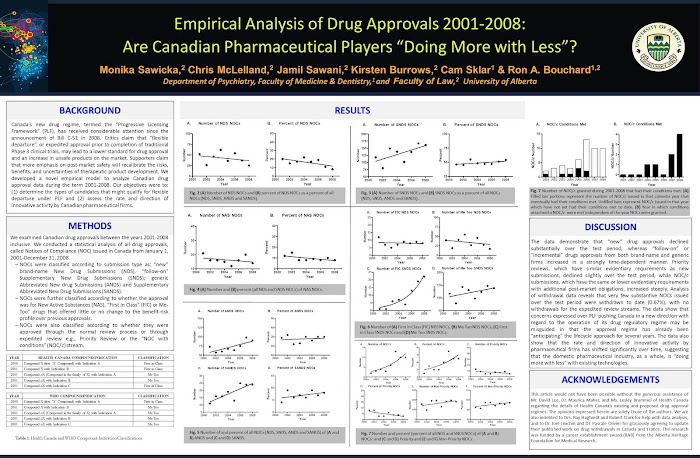
We have completed a substantial piece of empirical research on the use by multinational pharmaceutical firms of conventional patenting system and emerging linkage regulation regime to protect "high value" pharmaceuticals.

The work is a follow-up study to our paper currently in press with the Berkeley Technology Law Journal, which the journal called "influential and groundbreaking."

The work involved analysis of nearly 100 drugs and 4,000 patents. In addition to patent and linkage data, results were also analyzed within the context of a novel patent type classification scheme developed for this project (chemical, use, etc.) and the WHO therapeutic classification scheme (cardiovascular, antibiotic, etc.).

Update: The manuscript, entitled "Empirical Analysis of Drug Approval-Drug Patenting Linkage for High Value Pharmaceuticals", was published May 17, 2010 by the Northwestern Journal of Technology & Intellectual Property.

The article can be downloaded at: http://papers.ssrn.com/sol3/papers.cfm?abstract_id=1494455

Book- Strategic Patenting & Drug Development


Results from work done over the last three years by our group will be published in a book entitled "Patently Innovative: How Pharmaceutical Firms Use Emerging Patent Law to Extend Monopolies on Blockbuster Drugs."

Update : The book will be published by Biohealthcare Publishing (Oxford) Ltd. (Oxford, UK).

The manuscript was delivered in November 2010, and is set to be published in the summer of 2011. The book description is available at Amazon.com and other retailers.